|
CLAY ANALYSIS / CLAY IDENTIFICATION — SOUTH AFRICA
|
CONTACT DETAILS
PO Box 260787
EXCOM 2023
Republic of South Africa
|
|
|
|
|
|
Clay Analysis / Clay Identification in South Africa
SMI Analytical has developed various techniques to assist you with clay analysis across South Africa.
These range from X-Ray Diffraction (XRD) to Scanning Electron Microscopy (SEM), giving clients a complete picture of clay mineral composition, morphology and quantification.
Clay mineral identification is not an easy task — clay minerals are similar and are often interstratified with each other. At SMI Analytical we have adopted and developed techniques to aid in clay mineral investigation. These include: Heat treatment at 400°C and 550°C, Glycolation and Forced Ion Exchange. When due diligence is applied, clays can not only be identified as to their individual mineral components, but they can also be accurately quantified by Rietveld Methodology. This is a major advantage for many industries, where exact mineral quantification of clays is critical and eliminates the guesswork from clay-based formulations.
Clay Analysis and Clay Mineral Quantification is extremely important to all Ceramic Industries to formulate raw clay bodies and to examine resulting fired products. Clay analysis takes the guesswork out of formulating clay recipes for firing.
Road and Construction Industries must carry out clay analysis, as the Smectite family of clays swells dramatically when exposed to water. This expansion and contraction of the soil can cause extensive damage to buildings and their foundations, roads, and other structures — a significant concern across Gauteng and other regions of South Africa with naturally occurring expansive soils.
SMI Analytical has helped many international and local pharmaceutical and cosmetic companies with clay analysis. Clay analysis is important to establish that contaminants are not present — for example pesticides, herbicides and other hazardous chemicals. This is particularly important when clays are used as face packs and other cosmetic applications, as well as ensuring that clay-based formulations remain consistent batch to batch.
Clay Testing Applications by Industry
Clay analysis in South Africa is required across a wide range of industries. SMI Analytical serves clients in the following sectors:
Ceramics and Tile Manufacturing
South Africa has a significant ceramics and tile manufacturing industry. Accurate clay mineral quantification by XRD is essential to control the raw material composition entering the kiln. Variability in clay body composition leads to inconsistent firing temperatures, dimensional changes, and colour variations in the final product. By routinely submitting raw clay and fired samples for XRD clay testing, tile manufacturers can maintain tight quality control over Kaolinite, Illite, Feldspar and Quartz ratios in their formulations. Our fired-clay XRD analysis also confirms Mullite formation — the key ceramic mineral that develops above 1000°C.
Clay Brick and Construction Materials
Brick manufacturers across Gauteng, the Western Cape and KwaZulu-Natal rely on clay mineral identification to qualify new clay sources before commissioning quarries. Illitic and micaceous clays, with their interlocking plate structure, contribute significantly to the green strength of unfired bricks. Understanding clay mineralogy upfront prevents costly production failures. Road construction and civil engineering projects also require clay analysis to assess swell potential in subgrade soils — particularly critical in areas underlain by black cotton soils (Montmorillonite-rich Vertisols).
Mining and Mineral Processing
Clay contamination in ore bodies is a major problem in South African mining operations, particularly in gold, platinum and diamond mines. Swelling clays such as Smectite absorb significant quantities of cyanide leach solution, increasing reagent costs and reducing gold recovery rates. XRD clay testing of ore samples allows metallurgists to predict clay-related processing problems and design appropriate clay management strategies before ore is sent to the processing plant. Refer also to our respirable silica analysis services for dust-related hazards in mining environments.
Pharmaceutical and Cosmetic Industries
Medicinal and cosmetic-grade clays such as Kaolin, Bentonite and Fuller's Earth are used in face masks, antidiarrhoeals, tablet coatings and topical ointments. Regulatory compliance requires verification of clay mineral purity and freedom from hazardous contaminants. Our clay analysis service provides full XRD mineral identification combined with chemical screening to confirm suitability for these sensitive applications. Pharmaceutical clients require COC (Certificate of Conformance) documentation, which SMI Analytical can provide with each set of results.
Agriculture and Soil Science
Clay mineral content profoundly affects soil water retention, cation exchange capacity (CEC) and soil structure. Agricultural consultants and farmers in areas such as the Limpopo Lowveld, Mpumalanga Highveld and the Karoo use clay mineral analysis to guide soil amendment programmes. Understanding whether a soil is dominated by low-activity Kaolinite clays (common in weathered, tropical soils) or high-activity Smectite clays guides decisions on lime application, irrigation scheduling and structural drainage. See our related soil analysis services for a comprehensive soil testing package.
Environmental and Waste Management
Clay liners are used in tailings storage facilities (TSFs) and landfill sites throughout South Africa to contain contaminated leachate. The effectiveness of these liners depends on the clay mineralogy, particularly the proportion of Smectite which provides very low hydraulic conductivity. SMI Analytical performs clay quantification on liner materials and on samples from potential borrow pit sources to verify their suitability as containment barriers. This work supports NEMA (National Environmental Management Act) compliance. For occupational health sampling relating to clay and mineral dust exposure, see our occupational health sampling page.
Our XRD Clay Testing Procedure
At SMI Analytical, our XRD clay testing procedure follows internationally recognised protocols adapted for South African clay types. The complete analytical process involves:
Step 1 — Sample Reception & Logging: Each sample is logged into our LIMS (Laboratory Information Management System), assigned a unique sample number and visually inspected. Initial colour, texture and visible mineral content are noted.
Step 2 — Sample Preparation: Clay samples are dried at 60°C to remove free moisture, then disaggregated and milled to <75 microns. This is critical for XRD analysis as particle size affects diffraction peak intensity.
Step 3 — Oriented Clay Slide Preparation: For clay mineral identification, the <2 micron clay fraction is separated by sedimentation and pipetted onto glass slides to create oriented mounts. These mounts are essential for clay mineral identification as clay minerals show characteristic basal reflections only in oriented specimens.
Step 4 — Differential Heat Treatments: Three oriented slides are prepared from each sample: (i) air-dried, (ii) glycolated with ethylene glycol at 60°C overnight, and (iii) heat-treated at 400°C and 550°C. The response of clay basal spacings to these treatments is diagnostic for distinguishing Smectite, Vermiculite, Chlorite, Illite and Mixed-Layer Clays.
Step 5 — XRD Data Collection: Oriented slides and random powder mounts are analysed using our X-Ray Diffractometer (Cu K-alpha radiation). Scans are collected from 2° to 70° 2-Theta for quantitative work and from 2° to 35° 2-Theta for clay mineral identification.
Step 6 — Rietveld Quantitative Analysis: For quantitative clay mineral analysis, the full-pattern Rietveld refinement method is applied to random powder XRD patterns. Crystal structure models for each identified mineral are fitted simultaneously to the measured diffraction pattern, yielding weight percent values for each phase including clay minerals, quartz, feldspars and accessory minerals.
Step 7 — SEM-EDS Examination (Optional): Scanning Electron Microscopy with Energy Dispersive Spectrometry (SEM-EDS) provides direct imaging of clay crystal morphology and elemental composition. This is particularly useful for confirming interstratified clay minerals and documenting clay particle habit (platy, fibrous, blocky).
Step 8 — Report Issue: A comprehensive written report is issued with XRD scan images, mineral quantification tables and interpretive commentary. Electronic reports are emailed as PDF; hard copies available on request. Turnaround time is typically 5–10 working days from sample receipt.
Clay Analysis Pricing (South African Rand)
All pricing is quoted in South African Rand (ZAR) and is exclusive of VAT. Prices shown are indicative; complex samples or rush turnaround may attract a surcharge. Contact us for a formal quotation on project work or large sample batches.
| Analysis Type |
Description |
Price (ZAR, excl. VAT) |
Turnaround |
| Basic Clay Identification (XRD) |
Qualitative identification of clay minerals and major phases in bulk powder. Suitable for general clay characterisation and geological surveys. |
R 1 850 per sample |
5–7 working days |
| Clay Mineralogy — Full Oriented Clay Suite |
Oriented clay slides (air-dried, glycolated, heat-treated at 400°C and 550°C). Full identification of all clay mineral groups including interstratified phases. |
R 2 950 per sample |
7–10 working days |
| Quantitative Clay Analysis (Rietveld) |
Full Rietveld quantitative phase analysis (QPA). Weight percent of each mineral including clay minerals, quartz, feldspars and accessory phases. Includes full oriented clay identification. |
R 4 200 per sample |
10 working days |
| SEM-EDS Clay Imaging |
Scanning Electron Microscope imaging of clay crystal morphology plus elemental analysis by EDS. Minimum 5 representative images per sample. |
R 3 100 per sample |
7–10 working days |
| Fired Clay / Ceramic XRD |
Quantitative XRD of fired ceramic samples. Identifies and quantifies Mullite, Cristobalite, residual Quartz, glassy phase content and other fired phases. |
R 2 400 per sample |
7 working days |
| Comprehensive Clay Package |
Full oriented clay suite + Rietveld QPA + SEM-EDS imaging. Recommended for research projects, mine feasibility studies and pharmaceutical grade clay qualification. |
R 6 800 per sample |
10–15 working days |
Minimum 3 samples per order for discount pricing on large batches. Courier-collected samples within Gauteng can be arranged — contact us for details. Rush turnaround (2–3 working days) available at 50% surcharge.
How to Submit Clay Samples for Analysis
Submitting samples for clay testing in Pretoria at SMI Analytical is straightforward. Follow these steps to ensure rapid, accurate processing of your samples:
1. Contact Us First: Email or phone SMI Analytical before sending samples. We will issue a sample submission form (SSF) and discuss your specific analytical requirements. This ensures the correct test suite is selected and avoids delays.
2. Minimum Sample Size: A minimum of 100g of dry clay material is required for the full analytical suite (oriented clay XRD + Rietveld). For SEM work only, 10g is sufficient. If material is scarce, contact us and we will advise on what is feasible.
3. Sample Packaging: Pack clay samples in sealed zip-lock plastic bags or in sealed plastic sample jars. Label each bag or jar clearly with the sample ID matching your submission form. Double-bag powdered samples to prevent contamination. Do not use paper bags as clay powders will absorb moisture and paper will tear.
4. Sample Submission Form: Complete the SMI Analytical Sample Submission Form (available on request). Include: client name and contact details, sample descriptions, collection point/depth/borehole reference where applicable, analysis requested and any special instructions or safety information (e.g. if samples are contaminated with hazardous chemicals).
5. Delivery: Samples may be delivered to our laboratory in Gauteng by courier or hand-delivered during business hours (Monday to Friday, 08:00 to 16:30). We accept samples from across South Africa and southern Africa. Recommended couriers include DHL, Aramex, and RAM Couriers — mark packages clearly as “LABORATORY SAMPLES — NO COMMERCIAL VALUE”.
6. Results and Report Delivery: Results are emailed as a PDF report to the contact address provided on the submission form. A Certificate of Analysis (CoA) is included with all quantitative analyses. Data is also available in tabular format (Excel/CSV) for clients who need to integrate results into their own quality management systems.
For urgent project requirements or to discuss a multi-site sampling programme, contact SMI Analytical directly. We work with mining houses, engineering consultancies, ceramic manufacturers and government agencies throughout South Africa.
Clay Mineralogy
Below is an introduction to clay mineralogy
- Clay minerals are an important group of minerals because they are among the most common products of chemical weathering, and thus are the main constituents of the fine-grained sedimentary rocks called mud rocks (including mudstones, claystones, and shales). In fact clay minerals make up about 40% of the minerals in sedimentary rocks. In addition, clay minerals are the main constituent of soils. Understanding of clay minerals is also important from an engineering point of view, as some minerals expand significantly when exposed to water.
- Clay minerals are used extensively in the ceramics industry and are thus important economic minerals.
- Based on their structures and chemical compositions, the clay minerals can be divided into four main classes: (Some Clay Scientists refer to 2 or 3 classes for clays: Chlorite is sometimes referred to as a 2:1 layer not a 2:1:1 and Illites/Micas are sometimes grouped with Smectites)
Kandites 1:1 layered clays eg) Kaolinite
Smectites 2:1 layered clays eg) Montmorillonite
Illites/Micas 2:1 layered clays eg) Muscovite
Chlorites 2:1:1 layered clays eg) Clinochlore
The Kandites
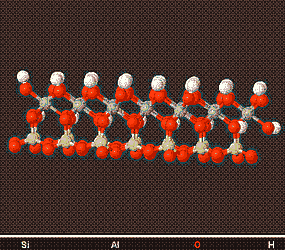
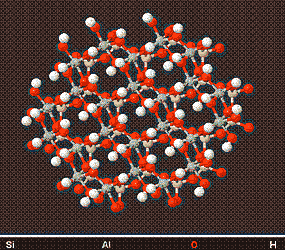
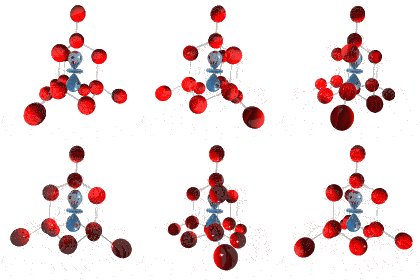
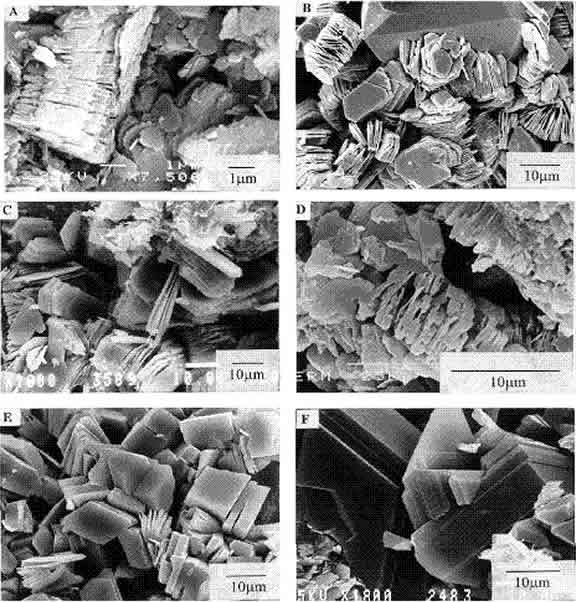
Above is a model of a Kaolin Crystal viewed from different angles, showing its structure. Kaolin minerals form plate-like structures which are visible by Electron Microscopy.
The Kaolinite family of Clay Minerals are formed by weathering or hydrothermal alteration of aluminosilicate minerals. Because of their chemical weathering resistance and non-swelling nature they are the clay of choice in ceramics and porcelain products.
The Smectites
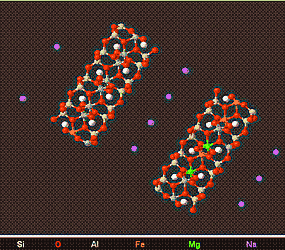
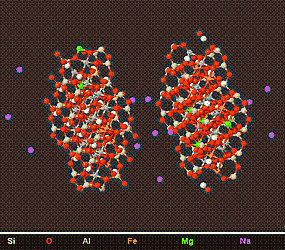
Above is a model of a Smectite Crystal viewed from different angles. The Interlayer space can clearly be observed and this accounts for the swelling nature of smectites.
Smectite-rich soils can undergo as much as a 40% volume change due to water being absorbed and desorbed in the interlayer space. The force behind this swelling is immense and can raise buildings and structures by a few centimetres, causing cracks and other problems. Due to their swelling nature, Smectites are useful as drilling mud (to keep drill holes open), and to plug leaks in soil, rocks, and dams.
The Illites/Micas
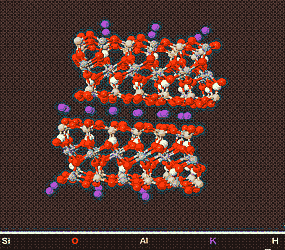
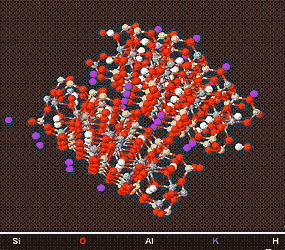
Above is a model of a Muscovite Crystal (a good example of an Illitic/Micaceous Mineral) viewed from different angles, showing its structure.
Illitic/Micaceous Clays are a major component of Ball clay, and as such have a major use in the ceramic and clay brick industry. Although Illites have an interlayer space, the attraction between the 2 plates is extremely strong, and prevents Illites/Micas from swelling when in contact with water. Many micaceous materials have a sheen and are used in metallic paints.
The Chlorites
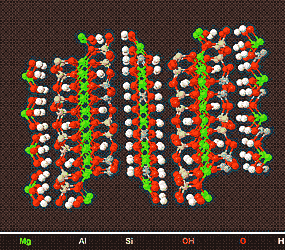
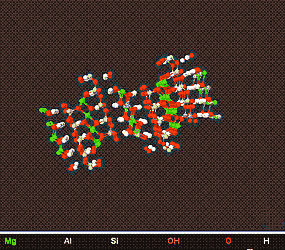
Above is a model of a Typical Chlorite Crystal viewed from different angles.
Chloritic clay is mainly associated with Illitic/Micaceous Clay and as such is used in the ceramic industry. It is easily weathered into other clay minerals, and as such is the least occurring clay mineral. In fact deposits of predominantly chlorite clay have yet to be discovered.
Pictures of Kaolinite and Illite
Below are Scanning Electron Microscope Pictures of Kaolinite Interstratified with Illite. Note the platelets of Kaolin are easily observed.
XRD Scan Comparison: Fired and Unfired Clay
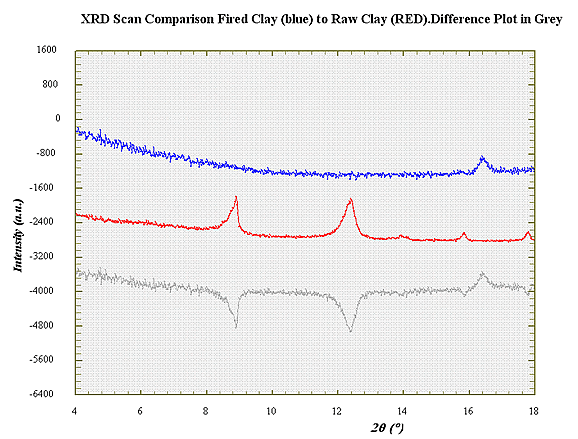
X-Ray Diffraction is a powerful tool in all mineralogical work. Below is an example of comparative XRD scans showing the change in Raw clay compared to Fired Tile. Clay was fired at 1150°C for 25 minutes.
Notice the clay peaks: Illite at 8.9° and Kaolinite at 12.3° 2-Theta have disappeared and a new peak at 16.5° 2-Theta has formed.
This new peak is the mineral Mullite. Mullite is what forms when clays are fired and is the mineral we associate with ceramics. The complete transformation of the clay mineralogy during firing can be tracked quantitatively using Rietveld refinement, enabling ceramic manufacturers to optimise firing schedules and verify product quality.
|
|
|
|
Disclaimer: The liability of SMI ANALYTICAL is limited to the cost of analysis. SMI ANALYTICAL indemnifies
itself from any legal action which may be instituted against it due to supplied data. SMI ANALYTICAL accepts
no responsibility whatsoever for any results released, however used. No part of this document may be reproduced
in part or in full unless permission from SMI ANALYTICAL is granted in writing. This document may not be altered
in any way whatsoever and is printed without correction.
|
Clay Chemistry Links
|
|
Analytical Lab
SMI Analytical Laboratory Services / Chemical Laboratory Services specializes in quantitative X-Ray diffraction
clay analysis South Africa, clay testing Pretoria, ceramic clay analysis, clay mineral quantification, XRD clay testing, clay identification, scanning electron microscopy clay minerals, clay testing, clay chemical properties, clay physical properties, swelling clay identification, clay quantification, XRD, SEM, clay pollution, clay testing, clay mining, clay quarry, clay for tiles, ceramic clay, ceramic properties, clay properties, clay lab
clay analysis, sampling, scanning electron microscopy, x-ray diffraction, SEM, XRD, ceramic industries, tile manufacturing, brick manufacturing, quantitative mineral analysis, clay phase, clay minerals, montmorillonite, smectite, illite, mica, kaolin, kaolinite, mullite, tile bodies, chlorite, clay mineral analysis, healing clay, mud packs, clay impurities, clay contaminants, clay face packs, cosmetic clay, pharmaceutical clay, laboratory, south africa,
site:, =, '.co.za', SA, RSA, za, 'loc:za'
|
|